
Useful, but not the whole trust boundary
App permissions and local policy remain important. RegenX/OS asks which decisions should also be represented beneath ordinary app processes.
Resilient & secure computing
Mobile security beneath the application layer.
RegenX/OS explores a hardened Android architecture that moves selected trust, privacy, audit, and communications controls deeper into the operating platform—reducing dependence on ordinary application-layer enforcement.
Research question
RegenX/OS examines where trust decisions should live when application permissions and user-space processes are not the only boundaries that matter.
RegenX/OS treats mobile security as a platform problem: selected controls span Android services, hardware interfaces, low-level enforcement, and hardware-backed trust rather than being concentrated in one app.
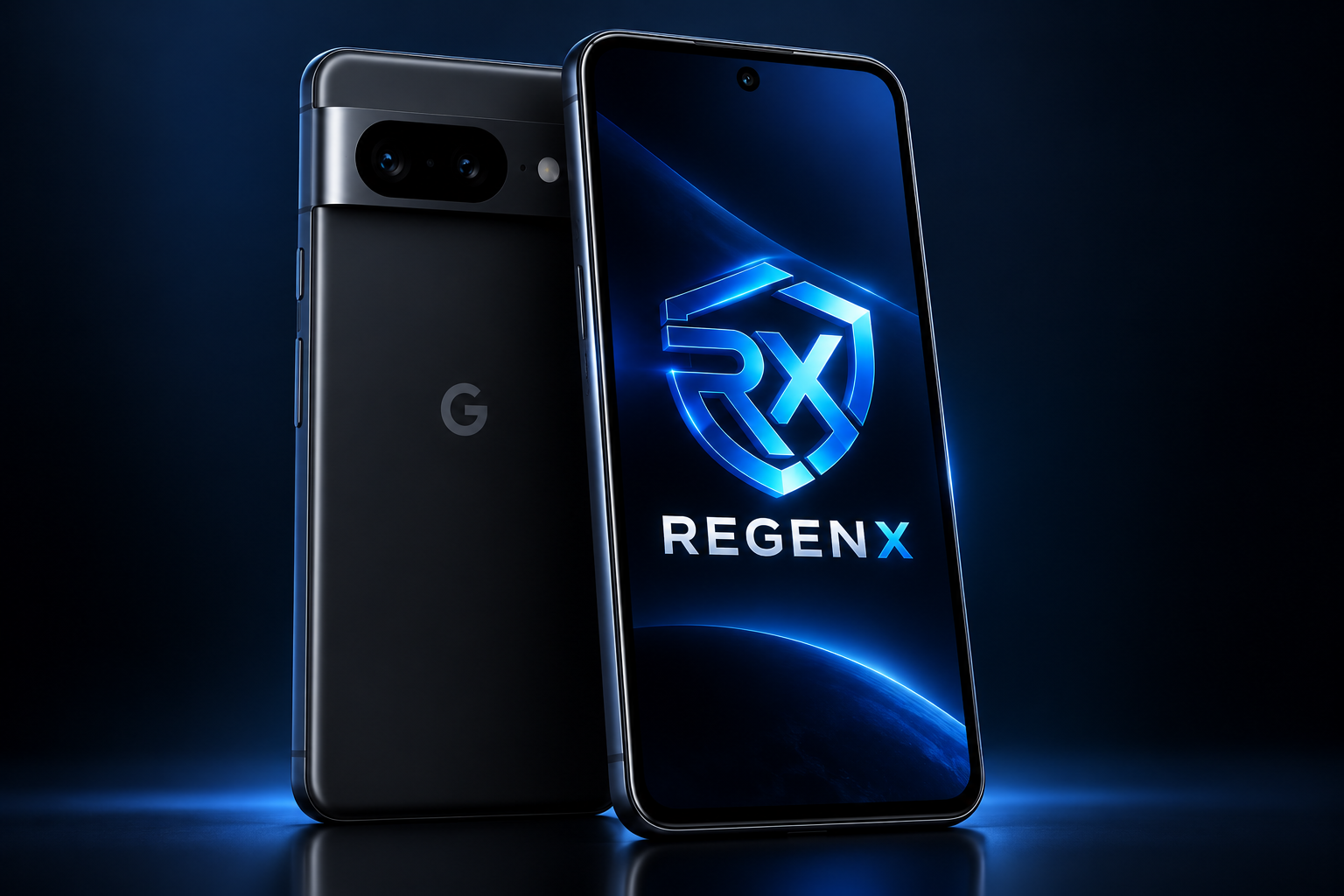
RegenX/OS is designed around Google Pixel 8 hardware, Android 15 AOSP, and Titan M2-backed trust. These define the architecture and integration targets; hardware validation remains a future milestone.
Why the platform layer
Application-level controls can be limited when the same application boundary defines both what they protect and where their authority ends.
App permissions and local policy remain important. RegenX/OS asks which decisions should also be represented beneath ordinary app processes.
Platform services, hardware interfaces, and low-level policy offer different points for coordinating privacy, audit, communications, and trust.
The architecture targets Titan M2-backed trust, while integration behavior remains subject to implementation and hardware validation.
The RegenX/OS approach
The architecture places each concern at the lowest practical boundary, then connects the layers through explicit platform interfaces.
Locate each trust or privacy concern at the platform layer best positioned to govern it.
Keep application, service, low-level enforcement, and hardware trust boundaries distinct.
Design audit, policy, communications, and response paths as related parts of one mobile architecture.
Advance from architecture to reproducible builds, then validate individual controls against defined device-level tests.
Platform architecture
The architecture distributes trust and enforcement across the platform while keeping security-sensitive implementation details private.
Google Pixel 8 · Android 15 AOSP · Titan M2 target
Core research areas
Each area represents a distinct security concern within the broader RegenX/OS architecture.
Explore key and identity boundaries tied to the Pixel 8's Titan M2 trust target.
Study camera and microphone policy at the hardware-interface layer, beneath ordinary app permissions.
Design an integrity-aware event path spanning low-level signals and platform-visible security state.
Investigate platform and low-level controls for managing outbound behavior and policy decisions.
Model coercion-aware access and lockdown behavior as an operating-platform concern.
Connect protected messaging and call paths to platform trust and local key boundaries.
Current development state
The platform model and implementation plan are defined; reproducible runtime and device behavior remain to be demonstrated.
Validation roadmap
These are future validation stages, not completed milestones.
Assemble and version the exact AOSP, kernel, resources, policy, and integration inputs.
Compile in a clean environment and retain a traceable build record.
Establish the device, image, boot path, and controlled diagnostic record.
Exercise one control at a time with a defined threat, environment, result, and limitation.
Share claim-specific artifacts after security, privacy, and rights checks.
Why RegenX/OS
Mobile devices concentrate identity, communication, sensors, and private data inside a platform that applications only partially control. RegenX/OS explores whether selected protections become more coherent when they are designed into that platform architecture.
It shares the wider RegenX focus on resilience and trust, but it is a distinct Android research effort—not the same implementation as the RegenX Windows engineering prototype.
Work with Korelis Labs
Android platform, kernel, hardware-security, and validation collaborators are welcome to start a focused conversation.